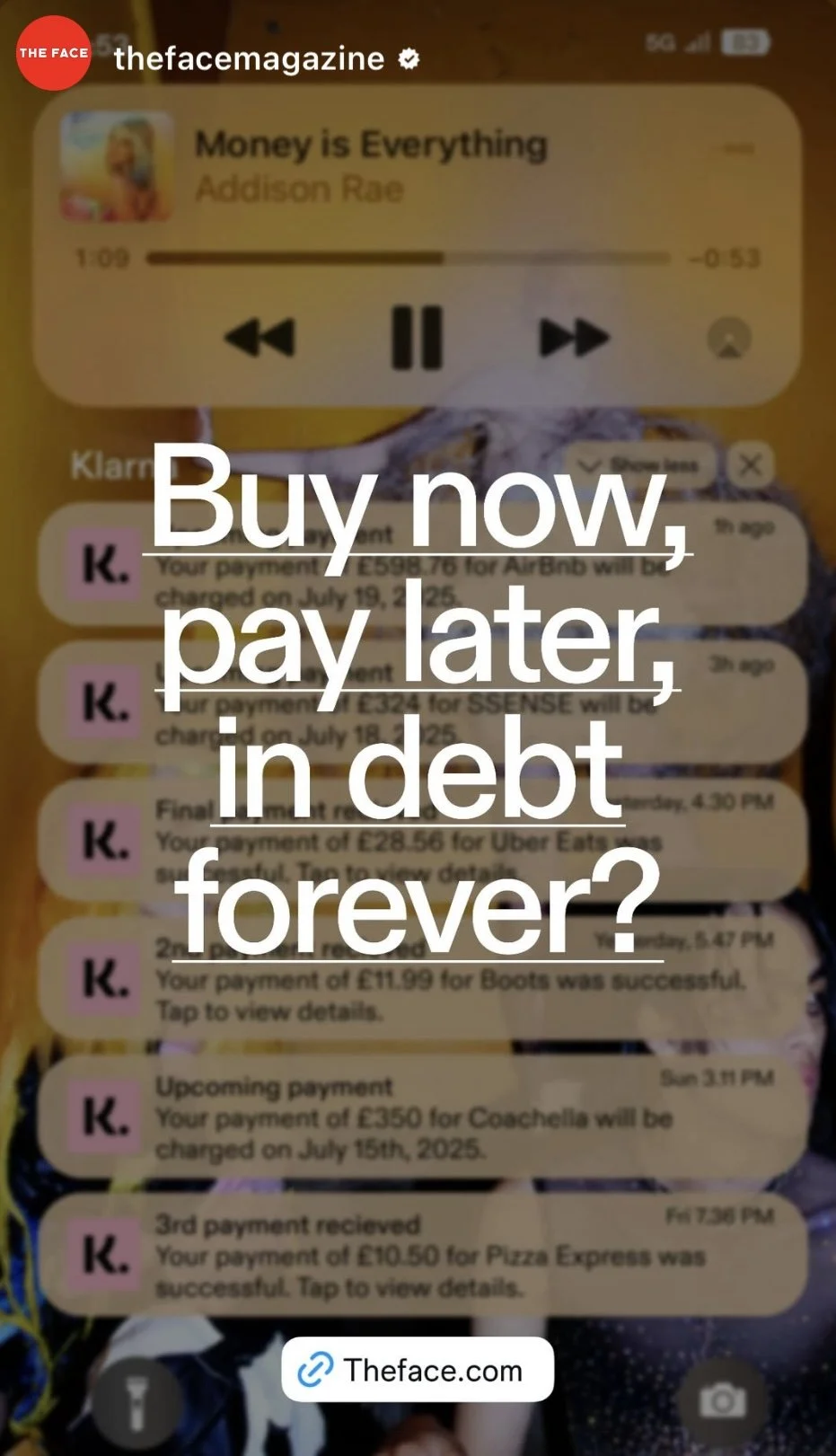
Buy now, pay later, in debt forever?
The Face
Editor’s Note: The below is a copy-pasted copy from an article published in July 2025 on the now defunct publication The Face
Sadie* leads something of a double life. A part-time model living in East London, she rents a spacious two-bed flat in Clapton with her best friend. She wears vintage Saint Laurent and Rick Owens, and is currently in Los Angeles visiting her boyfriend. Next month, she’s off to Paris. By all appearances, Sadie is a thriving 30-year-old woman. She’s also on Universal Credit, which means she doesn’t earn enough money to live on.
Her story does well to encapsulate the warped, trick-mirror era of financial contradiction we’re currently living in: online, it seems and looks like everyone’s having a great time. They live in small but perfectly formed flats in sought-after postcodes, dine at the city’s buzziest restaurants and holiday in trendy destinations. Scroll through Insta and you’ll see outfit photos posted ad nauseam, curated from wardrobes that appear to multiply exponentially.
The news, though, tells a different story. Headlines attest to food price hikes, outrageous rents, £7 pints and a job market that’s shot to hell. April 2025 was dubbed “awful April” by The Guardian, owing to across-the-board bill rises on everything from energy and water to car tax and phone bills. Add to this the looming threat of a recession, as vague yet present as an encroaching mist.
“You go on Instagram and everyone is somehow living their best lives,” says Ellie, 25, who works as a journalist. “I often wonder how anyone is living like this unless you’re secretly minted,” though she admits: “I guess if you go on my Instagram, you’d probably think the same.”
It’s true – Ellie’s feed reads like that of a carefree 25-year-old: cocktails by the beach in Madeira, techno festivals in Morocco, designer dresses and bags. “I probably returned all the clothes I’m wearing in those pictures,” she says. “It’s a trap.” This is likely the case for many of the people – both influencers and normies – whose online lives she covets, but that’s the thing about money: you always think you’re the imposter, not everyone else.
“You see these holidays and clothes [on other people’s Instas] and you think, well, my holidays aren’t as lush and my clothes aren’t as nice,” Ellie says. “It’s an insane thought to have, but your mind goes there because social media has conditioned you to want whatever you see.”
Offline, too, there is a palpable pressure to keep up. The trips, birthdays, dinners, hen do’s are incessant. “There’s always that pressure to chip in for stuff because it’s something we’ve always done for each other,” Sadie adds. “I want my friends to have nice gifts and meals and trips. It can [feel] impossible to say no.”
Enter buy now, pay later, otherwise known as BNPL. Four letters that have spelt doom for many a young person, including Ellie and Sadie. BNPL – short-term, interest-free loans offered by companies such as Klarna, PayPal and ClearPay – has existed for years as a niche type of credit card, but the rise of e-commerce dovetailing with the pandemic has caused a rapid surge in popularity. So much so that “Klarna” is now a common verb.
Approximately 60 per cent of Coachella tickets this year were purchased using BNPL, with many relying on it to also pay for lodging and merch. (Did you even go if you don’t have a £60 hoodie to prove it?) Lollapalooza in New York and Bonnaroo in Tennessee are seeing similar trends. Ellie is still paying off her £250 ticket for Primavera Sound in Barcelona: “I’m on month six of a nine-month payment plan.” Latitude Festival in Suffolk has even found a headline sponsor in Klarna itself.
Adding to your cart and then using BNPL to pay for it all has become second nature for many shoppers. Check out on anything from a one-week Airbnb stay to Deliveroo burritos and you’ll be tempted. And what’s more, this isn’t your parents’ credit. BNPL is young! It’s fun! It’s chill! It’s even endorsed by Paris Hilton!
StepChange, a leading debt charity, has long raised concerns about methods of marketing within the financial sector. “Our research, along with findings from the sector, indicates that many young people with limited financial experience may not fully understand that BNPL is a form of credit,” said Adam Butler, the company’s public policy manager. Up until 2022, Klarna wasn’t required to report customer debts to UK scoring agencies, meaning late payments didn’t affect your credit rating. The switch-up was likely the result of pressure from MPs and campaigners keen to regulate a wild west industry.
The heavy marketing of BNPLs in general doesn’t exactly help customers exercise caution, says Butler. “It doesn’t give people sufficient time to stop and think about the consequences of taking on credit [or] whether they will be able to meet the repayments later on.”
Ellie is a case in point. She first used BNPL to buy a dress on Asos for her birthday. A year later, she was thousands in the red, using it to pay for furniture, her groceries, her monthly Boots shop of loo roll and toiletries. BNPL can, in the simplest sense, be a slippery slope, used once for a special occasion before it becomes your go-to way to pay for daily essentials. The process itself is so easy, so quick – it’s also a life raft when suddenly you’re a little low on cash for your monthly shop because you went to Mallorca last week. A survey this month found that over one in 10 adults in the UK are using BNPL to cover essentials like food and petrol, with three in four admitting that they do not always think about whether they can keep up with repayments in the long term. (In the end, with no way to pay her debt back, Ellie had to ask her mum to bail her out; she is one of the very lucky few to have that financial parachute.)
Sadie, too, admits to a BNPL problem. That Saint Laurent bag and Rick Owens jacket? Klarna. “Having access to BNPL has made my relationship to money 100 per cent worse,” she says. “It’s so easy. It’s not like applying for a credit card or a loan; you can do it within a few seconds. Everyone I know buys stuff on credit.”
Everyone including Lily, a 28-year-old copywriter who puts everything – “I mean everything” – on her American Express card. “I never used to spend outside my means and now I’m doing it constantly,” she says. “And then I sort of just hope that at the end of the month I can pay it off. Usually I can’t.” What’s worse is she’s dipping into her actual savings, too. “My inheritance from my dad, about £40,000, which I’m not supposed to touch,” she says. “But I am.”
Young adults make up a disproportionately large share of those seeking debt support. Last year, 33 per cent of StepChange’s clients were aged 25 to 34 – nearly double their share in the UK population, where this age group makes up just 17 per cent. But blaming young people for their financial woes would be wrong and also inaccurate, like the myth that millennials forfeited home ownership in exchange for brunch.
Discretionary spending is hardly the main driver behind financial insecurity. One in 12 people turned to BNPL to cover basic costs, like food and toiletries, Citizens Advice found in 2022, with young people in debt and those claiming Universal Credit at least twice as likely to have used BNPL for essentials as the general population.
Whatever it’s used for, overreliance on BNPL can trap users in debt cycles, especially if job losses or emergencies hit – which is what happened to Sadie, who lost her job at an animation company in November last year. Since then, she has been trying to pick up more modelling work in between ad-hoc shifts cleaning houses and applying for jobs.
“The increasing cost of maintaining a household is making it more difficult for young people to save and build financial resilience to protect themselves from future financial shocks,” says Butler. For the most part, buying stuff isn’t what is making us broke; it’s food, rent, commuting costs, bills – it’s the cost of living, an ever-increasing price tag attached to being a person alive today. (Obviously, the unnecessary spending doesn’t help. Speaking with Sadie, Ellie, and Lily, all three know they shouldn’t be splurging on luxuries but it’s a small distraction from their troubling finances as a whole – a drop in the ocean, really.)
Stone, a 29-year-old who works in marketing, who is burning through her savings account, can’t see much point in saving. “At one point, with a decent salary and a £40,000 deposit, you’d be able to buy a house,” she says. “All I could buy is a garage or a shitty houseboat, not even a nice one. And that’s probably without the mooring fees. So every now and again, when I think, ‘Should I buy this top? Should I buy this festival ticket?’ I think fuck it, it’s not like I’m anywhere close to being able to afford a house.”
She isn’t the only one who feels this way; 42 per cent of adults aged 18 to 39 who did not own a home in 2023 had given up on the idea of buying one in the next decade. There’s a certain nihilism to her outlook. “It could be another 10 years before I’m in a position to be buying a house, and who knows what’s going to happen [by] then, bearing in mind we’ve lived through a pandemic, borderline World War III and the worst cost-of-living crisis in decades,” she says. “A nuclear bomb could go off and I’ll think, why have I left £4,000 in a NatWest savings account when I could have been enjoying myself?”
Still, it’s strange to see this disconnect going on. Social media no doubt plays a role, particularly in its latest evolution, which feels more lavish than ever thanks to what trend forecasters are calling the “boom boom” aesthetic. Trend analyst Sean Monahan, who previously had success in predicting normcore in the mid-2010s and the Noughties resurgence, describes ‘boom boom’ as “an expression of excess”. It calls back to the opulence of the Eighties with power suits and power lunches. Forget stealth wealth, this is in-your-face money à la Bezos-Sánchez. Or it appears to be.
To Monahan, the juxtaposition makes sense. “It may seem odd, but in times of economic insecurity, we often see very decadent aesthetics take hold,” he says from Los Angeles. “Boom boom is very much nostalgic for the late Eighties, which saw the stock market crash. There’s something a bit protective about embracing hedonism and consumerism. In some way, you’re saying that the bad economy isn’t affecting me.”
There is also, he adds, a cognitive dissonance when it comes to social media. “When you look at the world through that lens, it does seem as if everyone is happy and fit and attractive and rich – they don’t seem to work, but they have lots of clothing and luxury goods,” he says. “But influencers are selling you an entertainment product… they’re selling an illusion.” We know this is the case when it comes to celebrities and Hollywood, but with social media and influencer culture, we’re still struggling to see through the facade.
And sometimes, conspicuous consumerism isn’t the cause of financial instability either: it’s a symptom. Take the lipstick effect, a theory which posits that sales of lipstick increase in times of economic hardship because consumers, unable to afford big-ticket items, turn to little luxuries for a morale boost. It happened during the Great Depression in the 1930s and again after the -2008 crash. The same logic applies: you could die before you ever get on the property ladder, so why not go out to dinner? Similarly, student loan debt seems infinitely manageable (or at least further away) when you’re under the sun in Marseille.
More than any lofty philosophy, though, Monahan sees so-called Klarnamaxxing, a light-hearted term with serious connotations used by his friendship group, as the result of something more ordinary: an abundance of choice paired with a lack of financial literacy. “Private employment has allowed us more options, even down to being self-employed,” he says. “So you end up in a situation where people have choices and are maybe not making the best decisions. I don’t know if it’s nihilistic so much as humans not being great at managing their finances.” The fact secure and life-long employment is out of reach for many young people means a drastic, and often destabilising shift in how they approach their careers – and finances.
Dr Shay Harris-Pierre, a certified financial therapist, says many of her clients subscribe to the ‘treat yourself’ mentality. “We’re all operating at a baseline level of uncertainty and anxiety, and sometimes the most accessible way to achieve a level of happiness or that boost of dopamine is by buying something or spending £5 on a matcha,” she says.
It’s certainly why Sadie – someone who was raised to be “pretty good with money” growing up without an abundance of it in – falls prey to overspending on clothes. “I’ll buy things just to feel great,” she says. “If I feel like shit then I’ll buy something and it makes me feel instantly better.” Sometimes, she feels shit because she’s fighting with her boyfriend. Other times, she feels shit because she’s received another job rejection.
Therein lies the age-old crux of consumerism: the silent belief that if we acquire new and better things, we can make ourselves better in turn – that we can make ourselves whole. It’s a crushing disappointment, then, when that feeling wears off the instant a package arrives on Sadie’s doorstep, replaced by a scorching sense of guilt, followed by shame, that gets kicked into overdrive whenever she opens the Klarna app. “You see the money there and suddenly you realise, you really didn’t need those shoes.”
For Ellie, figuring out how to pay her debt back (before her mum stepped in) opened up a well of anxiety. “I felt very burdened by it,” she says. “I’d be alone and constantly checking my credit balance, thinking, how am I going to make a dent in this? It made me miserable.” The balance hung like an albatross around her neck, which was already bearing the heavy weight of student loans, the repayment of which makes it even harder to build up a nest egg.
Harris-Pierre is careful not to downplay the psychological toll that financial instability can take, no matter how small it is. “When we think about living in a capitalist society, money is tied to our survival, so when we’re in debt, when our finances are threatened, it can feel like a threat to our basic needs. What we might brush off as just a bit of money anxiety is actually a very deeply ingrained stress that is triggered by that survival instinct.”
A big part of a financial therapist’s job is to break the silence – and with it, the shame – that typifies conversations about money. Happily, young adults are starting to speak about it. Lifestyle creep, doom spending, soft saving, bougie budgeting – every day, our cultural lexicon expands to accommodate this new financial candour. That said, Harris-Pierre says, “We need to push these conversations further to actually make a difference and improve financial literacy.” We can’t stop at memes, is her point. Girl math jokes aren’t going to change anything.
*Names have been changed
[ends]